
It's Not the Clock: What Actually Shapes Creativity Under Pressure
Deadlines feel like they make or break creative work, but decades of research suggest pressure on its own says surprisingly little about how creative we will be. What matters more are the conditions around it, and how we can shape them for ourselves and our teams.

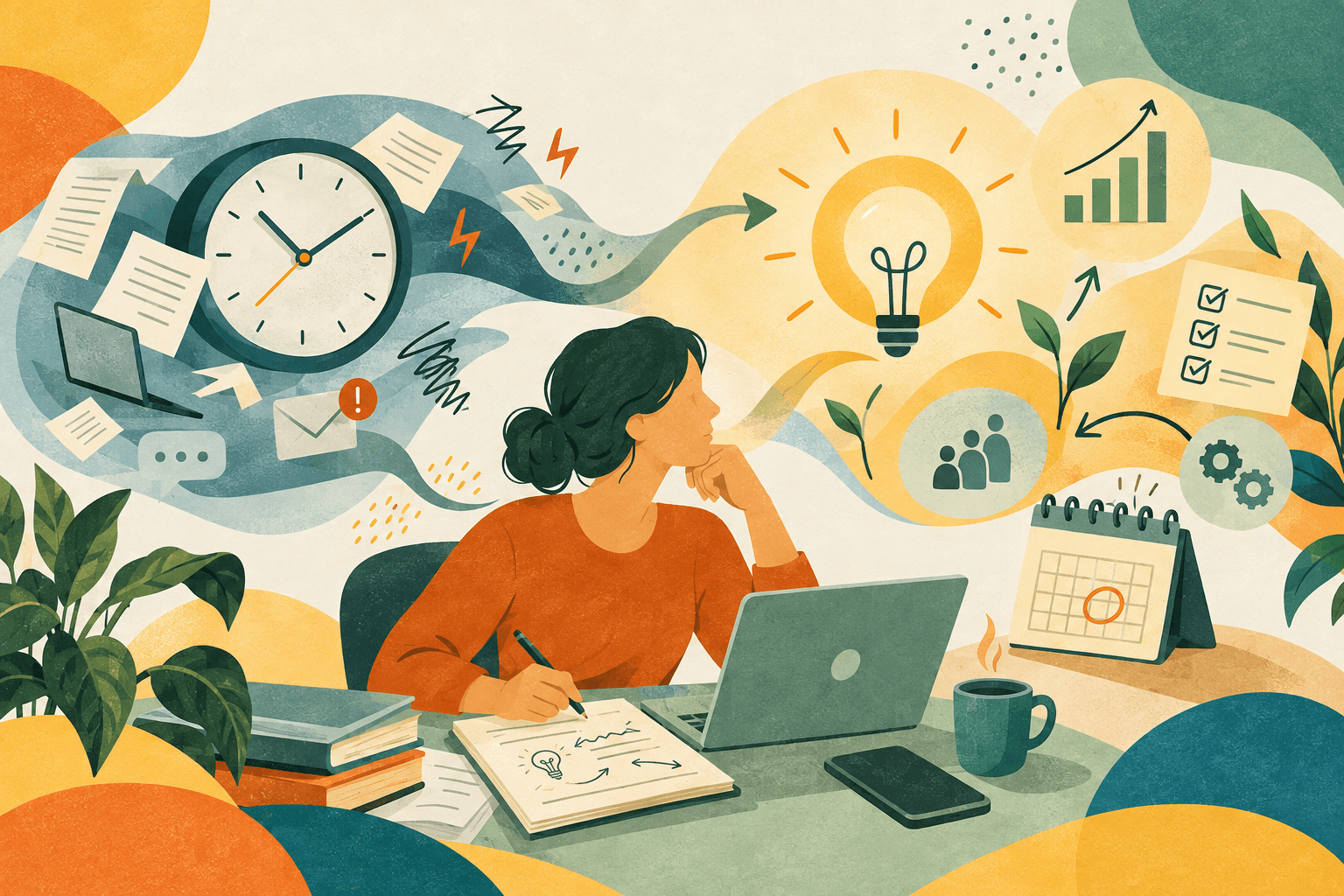
Most of us know the feeling. The work arrives faster than the time to do it. A new request lands from your boss, a colleague leaves and their projects become yours, or a round of layoffs means the same work spreads across fewer people. Somewhere in all of that, you're still expected to come up with something new, and it can feel like a squeeze.
If you lead a team, you know the other side of it too. You're the one deciding what to pass along, who absorbs the extra work, and how much more to ask of fewer people, while still hoping for fresh ideas.
Whether that pressure helps or hurts depends on who you ask. Some people swear a deadline brings out their best ideas, while others say pressure takes away the room for creative work. Chances are you've lived both. The research tells a different story. Pressure on its own, including the clock itself, predicts surprisingly little about how creative we will be, and what seems to matter more is the conditions surrounding it.
What the research says about pressure
When we talk about pressure, we mean the experience of facing substantial demands at work, whether they come from tight deadlines, heavy workloads, or high expectations for performance (Gutnick et al., 2012). Researchers have been trying to settle this debate for decades, and the evidence has pointed in nearly every direction. Some studies have found that pressure undermines creativity (Amabile, Hadley & Kramer, 2002; Oldham & Cummings, 1996; Shalley & Perry-Smith, 2001). Others have found that it can boost creativity, or help, up to a point before it starts to hurt (Baer & Oldham, 2006; Eisenberger & Aselage, 2009). Still others, including my own dissertation research, have found that it makes little measurable difference (Amabile et al., 1996; England, 2023; Hsu & Fan, 2010).
When researchers step back and combine the evidence, the overall relationship mostly fades. A review that pooled 76 experiments on stressors such as time pressure, competition, and evaluation found an average effect on creativity close to zero, explaining less than one percent of the differences in how creative people were (Byron, Khazanchi & Nazarian, 2010). A more recent synthesis of 50 workplace samples found only a small link between time pressure and innovation, and one that swung widely from study to study (Song et al., 2023). The researchers behind the larger review concluded that calling pressure simply good or bad for creativity is an oversimplification, because its effect depends on what kind of pressure it is and how intense it becomes.
So "does pressure help or hurt creativity?" may be the wrong question. Pressure is a fact of working life, and the more useful question is what surrounds it and how we adapt to it. Across the research, four conditions stand out.
Is there room to think?
Picture a work week with a few big deliverables coming due. Your mornings are clear, you have a couple of meetings in the afternoon, and you've got real time to sit down and think through your work. Now picture a week with the same deliverables, except every hour is spoken for. Meetings run back to back, messages keep arriving, and each new request pulls you onto something else.
Only one of those weeks leaves room to think, and that difference shows up in creative work. In a study of manufacturing employees, people who felt they had no time to develop new ideas, agreeing with statements like "thinking of new ideas takes time I don't have," were rated as less creative by their supervisors (Baer & Oldham, 2006). Interruptions are a big part of how that time disappears. Each one breaks concentration and costs time to get back into the work, and together they add pressure even when the workload itself hasn't changed (Jett & George, 2003).
When that room disappears, it's tempting to hand the thinking off. In one survey of knowledge workers, people said time pressure kept them from critically reviewing what AI tools produced, or as one salesperson put it, "I use AI to save time and don't have much room to ponder over the result" (Lee et al., 2025). As we explored in AI Is Not Innovation. It Is a Tool That Can Help or Hinder Creativity, AI tends to pull us toward the probable answer, so under pressure it matters whether we use it to think further or to skip thinking entirely.
The scarcest resource under pressure often isn't time in general but uninterrupted time to think. Breaks are one way to get it back, and their effects depend on the conditions too, which we'll explore in a future post.
Does it feel like a mission or a squeeze?
Two people can face the same deadline and experience it completely differently. For one, it feels like urgency on something that matters. For the other, it feels like being squeezed, with someone watching over their shoulder.
Researchers describe what’s happening here as an appraisal. When a deadline lands, we size up whether it’s a challenge we can meet or a threat we can’t (Gutnick et al., 2012). Two things seem to tip that appraisal one way or the other: whether the work feels meaningful, and whether we feel any control over it.
The first is meaning. A long line of creativity research suggests people do their most creative work when they are driven by interest in the work itself and a sense that it matters, more than by outside pressure or rewards (Amabile, 1985; Hennessey & Amabile, 1998). Pressure can feed that motivation when it feels like a natural part of important, urgent work, and drain it when it feels imposed as a way of controlling people (Amabile et al., 1996). Work environments that offer challenging, meaningful work are consistently linked to more creativity across studies and settings (Hunter, Bedell & Mumford, 2007).
The second is control. In the review of 76 experiments described earlier, studies that added elements outside people’s control, such as a harder or more time-limited task, discouraging feedback, or distractions, tended to lower creativity. Evaluation cuts both ways. Being told your work would be judged was linked to small gains, but heavy scrutiny, such as being watched while also being compared with others, was linked to a sharp drop (Byron, Khazanchi & Nazarian, 2010).
The deadline may be fixed, but why the work matters and how you approach it usually are not. Holding onto those is what makes pressure feel more like a mission than a squeeze.
What surrounds you?
The environment around pressure can matter as much as the pressure itself. A large review of research on creative work climates found that the environment became an even stronger influence on creativity in high-pressure settings (Hunter, Bedell & Mumford, 2007). Individual studies point the same way. In a study of 645 employees, time pressure was linked to more learning and innovation when supervisors gave feedback aimed at helping people improve. Without that feedback, the same pressure was linked to less of both (Song et al., 2023). In the manufacturing study described earlier, moderate pressure went with higher creativity only for people who had real support for their ideas from supervisors and coworkers (Baer & Oldham, 2006).
A supportive environment also avoids stacking demands that pull in opposite directions. In a study of 335 employees, pressure to produce was more exhausting when people were also expected to innovate (Aksoy, 2025). When innovation and output compete, support can be as simple as saying which one takes priority.
Did you see the crunch coming?
It also helps to see a deadline coming. Knowing a constraint early lets people build their whole approach around it, while learning about it late usually means patching work that's already underway. In one experiment, people who learned about limits such as a small budget and a short timeline before defining the problem produced the strongest problem definitions, while those who got the same limits midway mostly adjusted the ideas they already had and turned in weaker final proposals (Medeiros et al., 2018).
Looking further ahead helps for a similar reason. Among 203 knowledge workers, time pressure was linked to people looking less beyond their own organization for ideas, one route to fewer radically new ones, but that link largely disappeared for people who planned months ahead rather than day to day (Zhang et al., 2023). A crunch you can see coming is something you can plan around. One that's sprung on you midstream leaves you reacting instead of planning.
Managing the squeeze
The new request will still land, colleagues will still leave, and some weeks will always hold more work than time. But as the research suggests, pressure alone isn't what decides whether good ideas survive it.
I saw this recently in my work supporting innovation in the federal government, where teams have been operating in a turbulent environment. Many are smaller than they used to be, are delivering more for their mission, and get little notice when priorities shift. We asked people who were already stretched thin to make time to share their projects with colleagues across the organization. We couldn't change the pressure they were under, but we could shape the conditions around what we were asking. We tied the request to the impact of their work on the mission, and we supported them as they prepared. People showed up and thrived, learning about one another's work and setting the stage for future collaboration.
Not every condition will be within reach every time, but most of us can influence at least one, for ourselves and for the people we work with. Here's where to start.
Making room to think
- Block thinking time on your calendar the way you would a meeting, so it’s harder for others to book over it. If you lead a team, check how many meeting-free stretches longer than an hour people actually have in a typical week.
- Notice which interruptions you start yourself, like checking messages mid-task, and save them for a natural stopping point. For a team, agree on how quickly messages really need an answer.
- Before turning to AI under a deadline, jot your own ideas down so the tool builds on your thinking rather than replacing it.
Turning a squeeze into a mission
- Before you start, put into one sentence who the work helps and why it matters to them.
- When a deadline feels like a squeeze, name one part of the work you control, like how to break it down or where to begin, and start there.
- If you set or pass along deadlines, explain why they exist and what’s fixed versus flexible.
- Evaluate work against clear criteria that everyone knows from the start, rather than by comparing people or watching over their shoulders. If you’re not sure what the criteria are, ask.
Creating an environment of support
- Ask for feedback early, framed around what would make the work better. If you lead others, offer it the same way while their work is still in progress.
- Find a thinking partner, or offer to be one for a colleague and ask them to return the favor. If you lead a team, make sure no one is working through a crunch alone.
- When new ideas and output targets compete, get clear on which comes first rather than trying to do both at full speed. If you set the priorities, make the call and share it with your team.
Helping people see the crunch coming
- At the start of a project, ask what constraints are likely, including deadlines that might move, so you can define the problem with them in mind. If you lead a team, share the ones you know about up front, even the inconvenient ones.
- Set goals for the coming months, not just today, so a sudden crunch doesn’t wipe out your view of where the work is heading. For a team, map milestones a few months out so everyone can plan ahead.
- If you hear about a deadline late, step back and ask whether the problem has changed before you start patching what you have. If you’re the one delivering late news, give people room to do the same.
When the conditions are not there
Sometimes none of these are within reach, and it's worth saying so. A two-day turnaround on a problem that deserves two weeks will probably get a workable answer, not your most creative one. Naming that trade-off out loud, to yourself and to whoever set the deadline, is more honest than pretending otherwise, and it helps everyone decide whether a workable answer is good enough this time.
None of this makes the pressure go away. The clock will keep running. The conditions around it are where the difference gets made.
Which of these four conditions is weakest for you or your team right now? We'd love to hear what you're seeing.
Found this useful?
Share it with your team or follow for more.
Get new insights delivered weekly
Join our community of practitioners who care about impact.
Or follow us on LinkedIn for daily insights